
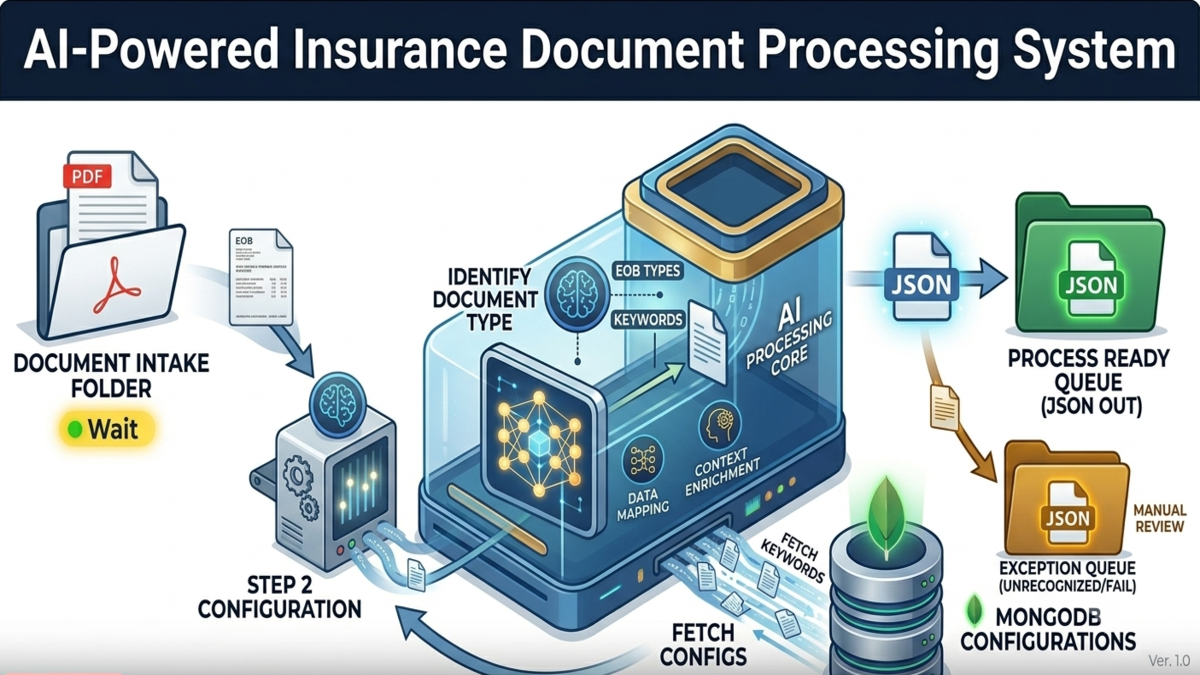
About This Project
Processing insurance documents manually is a time-consuming and error-prone task due to the large variety of document formats, layouts, and information structures used across insurance providers. Traditional document processing systems require extensive manual configuration and frequent code changes whenever a new document type or extraction requirement is introduced.
This project presents an AI-powered intelligent document processing system that automates insurance document understanding, classification, data extraction, and validation using a combination of OCR, machine learning, and Large Language Models (LLMs).
The system is designed with a configuration-driven architecture, allowing new document types, extraction fields, and validation rules to be introduced without modifying the core application code. Instead, document behavior is controlled through database configurations containing document mappings, identification keywords, extraction rules, and field definitions.
The pipeline combines document classification, OCR-based text extraction, intelligent page identification, AI-powered information extraction, and structured output generation to process complex insurance documents efficiently.
Key Features
- Processes multiple insurance document types automatically
- Identifies document categories using configurable identification rules
- Extracts relevant pages using keyword-based validation logic
- Performs OCR-based text extraction from scanned and digital documents
- Uses AI/LLM-based extraction to capture structured insurance information
- Supports dynamic field mapping through database configurations
- Eliminates the need for code changes when onboarding new document types
- Handles different document layouts and variations from multiple providers
- Generates structured JSON outputs for downstream applications
- Provides processing logs, validation results, and error tracking
System Architecture Overview
| Stage | Method | Purpose |
|---|---|---|
| 1. Document Ingestion | File processing pipeline | Receive and prepare insurance documents |
| 2. Document Classification | Rule-based + AI classification | Identify document type automatically |
| 3. Page Identification | Keyword matching + validation rules | Select relevant pages for extraction |
| 4. OCR Processing | OCR engine | Convert document images into machine-readable text |
| 5. Information Extraction | LLM-based extraction + field mapping | Extract structured insurance data |
| 6. Validation | Configurable validation rules | Verify extracted information accuracy |
| 7. Output Generation | JSON structured response | Provide extracted data for downstream systems |
Core Components
1. Intelligent Document Classification
The system automatically determines the type of incoming insurance document by analyzing:
- Document-level identification keywords
- Text patterns
- Metadata
- Configured document rules
New document types can be enabled by adding configurations to the database without modifying application logic.
2. Dynamic Page Detection
Instead of processing every page in a document, the system identifies relevant pages using configurable validation keywords.
The workflow:
- Extract text from document pages
- Compare extracted content with configured validation keywords
- Select matching pages
- Send only relevant information for extraction
This reduces processing time and improves extraction accuracy.
3. AI-Powered Information Extraction
The extraction engine uses Large Language Models to understand complex insurance documents and extract required information.
Capabilities include:
- Understanding different document structures
- Mapping extracted text into predefined fields
- Handling variations in terminology
- Extracting contextual information rather than simple keyword matches
4. Configuration-Driven Field Mapping
- A key feature of the system is its flexible configuration architecture.
- Instead of hardcoding document-specific extraction logic, all document processing rules are managed through database configurations.
Key Advantages
-
No-Code Document Onboarding - configuration updates instead of modifying application source code. This allows business teams to support new document types faster while reducing development effort.
-
Scalable Architecture - The system is designed to support a large number of insurance document types by extending configuration records instead of creating separate processing pipelines.
-
Improved Accuracy
The system combines:
- OCR-based text extraction
- Rule-based document validation
- AI-powered contextual understanding
- Configurable extraction logic
to improve the accuracy of extracted insurance information.
- Reduced Manual Processing - The platform automates repetitive document review and manual data entry activities, allowing faster claim and policy document processing.